
MUIS HR System Cyber Incident: What Singapore Businesses Can Learn About Third-Party Cyber Risk
On 15 September 2026, Channel NewsAsia reported that the Islamic Religious Council of Singapore (MUIS) had experienced a cybersecurity incident involving a human resource management system operated by Singapore-based software vendor Avelogic.
According to the report, the incident did not affect the delivery of public-facing or government services. MUIS said business continuity arrangements had been implemented to support essential HR and payroll functions, while affected employees were being provided with guidance and support.
The Singapore Police Force confirmed that a report had been lodged and investigations were ongoing. The Personal Data Protection Commission (PDPC) was also investigating a data breach notification filed by Avelogic.
Avelogic subsequently said an independent forensic investigation found no evidence of bulk data exfiltration based on available AWS network telemetry covering confirmed threat-actor activity. The company also stated that core sensitive data fields in its SmartHRMS platform remained protected by application-layer encryption.
Investigations were still ongoing at the time of reporting, so conclusions should not be drawn about the ultimate cause, scope or impact of the incident.
The Bigger Lesson: Your Cyber Risk Extends Beyond Your Own Network
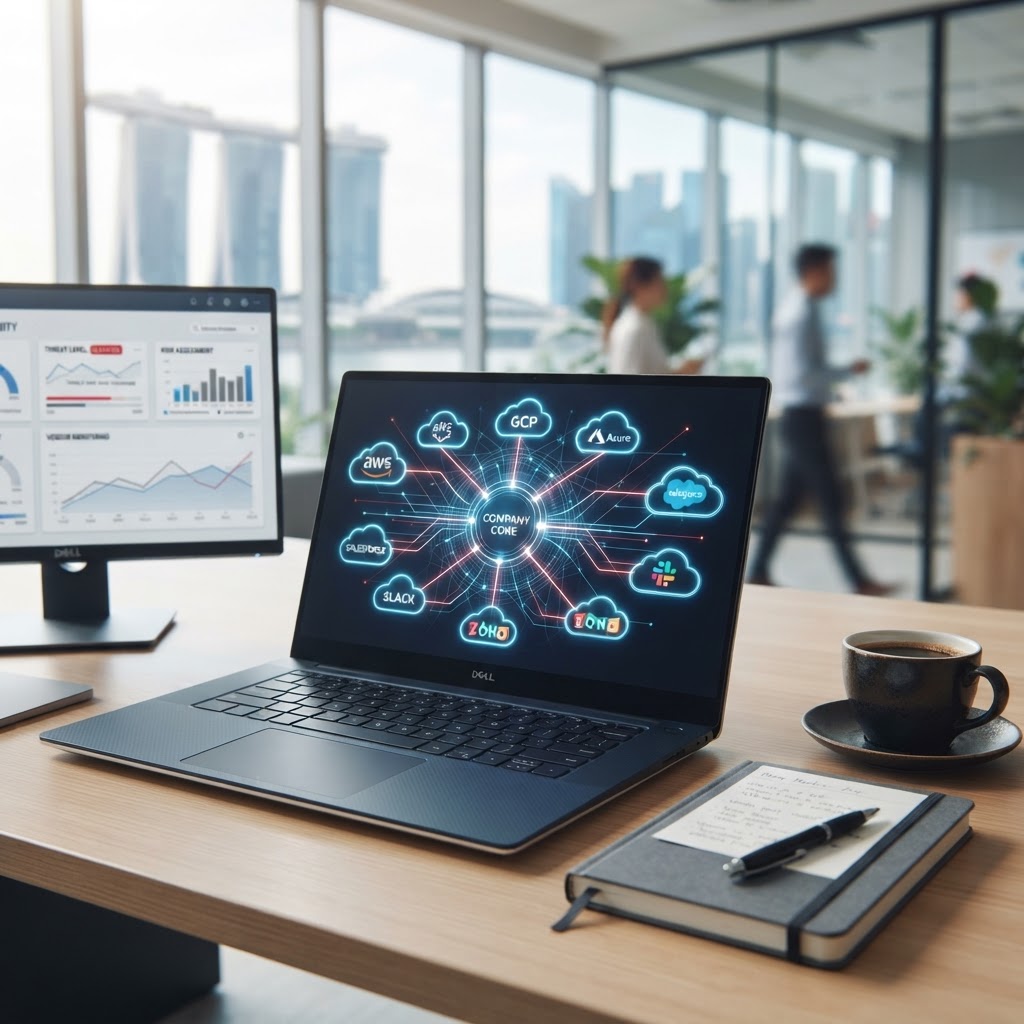
For Singapore businesses, incidents such as this highlight an increasingly important cybersecurity reality: protecting your own laptops, firewall and Microsoft 365 environment is only part of the picture.
Businesses routinely entrust operational and sensitive information to external platforms — payroll systems, HR applications, accounting software, CRM platforms, cloud services and other SaaS providers.
Even where an organisation maintains good internal security controls, a disruption affecting an important technology provider can still affect normal business operations.
This makes third-party technology risk part of the organisation's overall cybersecurity and business-continuity planning.
1. Know Which External Systems Are Business-Critical
Not every cloud application presents the same operational risk.
Organisations should maintain visibility of the external systems used for important business functions and understand what would happen if one became temporarily unavailable.
Payroll, HR, accounting, customer information, communications and identity services deserve particular attention because disruption can quickly affect employees, customers or day-to-day operations.
Businesses should know who owns each system internally, what information it contains, how access is controlled and who should be contacted if the service is disrupted.
2. Business Continuity Matters Alongside Cybersecurity
An important detail in the MUIS response was the activation of business continuity arrangements for essential HR and payroll functions.
Cybersecurity planning should therefore ask not only, "How do we prevent an incident?" but also, "How does the business continue if an important system becomes unavailable?"
Depending on the organisation, this may involve documented alternative processes, clearly assigned responsibilities, escalation contacts, backup information and communication procedures.
No security technology can guarantee that an organisation or one of its suppliers will never experience an incident. Resilience therefore requires both protection and recovery planning.
3. Review How Third-Party Access Is Controlled
External applications increasingly connect with other business systems through user accounts, APIs, integrations and cloud permissions.
Businesses should periodically review which applications are connected to their environment, what permissions they have and whether those permissions remain necessary.
This is becoming particularly important as organisations adopt more cloud and AI applications that can request access to Microsoft 365 data, identities and services.
Multi-factor authentication, appropriate administrator privileges, account lifecycle management and regular access reviews can reduce unnecessary exposure.
4. Protect the Environment Around Cloud Applications
Using cloud services does not eliminate the need to secure endpoints, identities, email and networks.
A practical security strategy should consider multiple layers: endpoint protection and monitoring, email threat protection, identity and account security, patching, managed network security, backup and recovery, and monitoring of the Microsoft 365 environment.
The objective is not to depend on a single security product. It is to make it harder for one compromised account, device or service to develop into a broader business incident.
5. Ask Vendors the Right Questions
Businesses do not need to perform a full cybersecurity audit of every software supplier, but they should understand the controls surrounding systems that handle important or sensitive information.
Useful questions include:
- What information will the provider store?
- Where is that information hosted?
- How is sensitive information protected?
- What authentication and access controls are available?
- What happens if the service becomes unavailable?
- How does the provider respond to and communicate security incidents?
- What options exist for recovering or exporting business data?
The level of scrutiny should reflect the importance and sensitivity of the service.
What Singapore SMEs Should Review Now
This incident provides a useful reason for businesses to review their own environment rather than assume that cybersecurity stops at the office firewall.
Start by identifying your critical cloud and third-party applications. Review who has access, confirm that former employees and unnecessary administrator accounts have been removed, check that multi-factor authentication is used where available, and document what the business would do if a critical service became temporarily unavailable.
Organisations should also review whether endpoint, email, identity, network and backup controls are being actively monitored rather than simply installed.
For smaller organisations without a dedicated internal IT and cybersecurity team, having clear ownership of these areas is particularly important.
Building Cyber Resilience Beyond the Endpoint
Modern cybersecurity is no longer only about protecting PCs from malware. Business information and operations now span endpoints, Microsoft 365, cloud applications, identities, networks and external service providers.
The practical objective is therefore resilience: reducing the likelihood of an incident, detecting problems early, limiting their impact and having a workable recovery plan when disruption occurs.
iXiZ Technology helps Singapore businesses manage IT infrastructure, Microsoft 365, endpoint security, networking, monitoring and cybersecurity as part of a coordinated managed environment.
Need help reviewing your organisation's IT and cybersecurity environment? Contact the iXiZ team to discuss your current setup and areas of exposure.
Source: Channel NewsAsia, "MUIS says human resource management system hit by cybersecurity incident", published 15 September 2026 and updated 16 September 2026.
Need help strengthening your business IT and cybersecurity?
iXiZ Technology helps Singapore businesses manage IT operations, endpoint security, Microsoft 365 and business networks through practical managed services.